


- ACTUALITÉ
- 31
- August
- 2023
S'inscrire
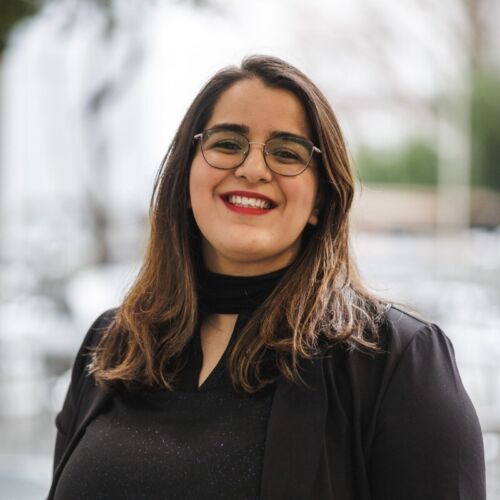
Montreal boasts a rich and vibrant cultural landscape, with internationally renowned festivals and well-established institutions. Yet despite this vitality, some narratives circulate less freely than others. Certain voices still struggle to find sustainable spaces where they can fully express themselves, beyond one-off programs or symbolic showcases.
It is at this intersection that the journey of Vanessa Kanga.
After graduating from the University of Montreal with a degree in economics and politics, followed by a degree in international management from ENAP, she began her career in 2008 at Carrefour Jeunesse-Emploi Côte-des-Neiges. There, she worked with young people from sometimes vulnerable backgrounds in a neighborhood marked by great cultural and socioeconomic diversity. She observed firsthand how institutional, economic, and cultural systems influence individual trajectories.
An artist and musician since childhood, she naturally moved between two worlds: the analytical rigor of public policy and the creative sensitivity of the arts. But she quickly asked herself a question: how can we ensure that talented individuals from African-descendant communities are not only invited to participate, but can truly shape the cultural landscape?
For her, building bridges means connecting emerging artists of African descent to institutional networks, facilitating the circulation of works between Montreal, Africa, Europe, and the diasporas, and creating collaborations that transcend silo thinking. It is not just about connecting individuals. It is about structuring exchanges between artistic circles, cultural decision-makers, and communities.
In 2012, she founded the Festival Afropolitain Nomade. The project did not arise from a “void” in the sense that no Afro-descendant events existed. Montreal has long been home to major initiatives such as the Festival international Nuits d'Afrique. But Vanessa observed something else: a lack of transnational spaces dedicated to contemporary Afro-descendant artistic practices that cross disciplines, generations, and territories.
She notes that many artists operate within fragmented networks: some are internationally recognized but have little visibility locally, while others are very active in their communities but lack access to major venues. The Afropolitain Nomade Festival therefore positions itself as a platform for circulation and mutual recognition.
Why not wait for more solid institutional validation before launching? Because, according to her, waiting could mean letting careers fade away or stories remain invisible. The challenge was not only artistic, but structural: to create a scene where artists of African descent would not only be invited on an exceptional basis, but recognized as bearers of legitimate contemporary aesthetics.
Since its creation, more than 450 artists from the visual arts, music, performance, and interdisciplinary arts have been supported or programmed as part of the festival. Several have found international collaborations, institutional partners, or a wider audience.What convinced her to continue despite the difficulties was not the media coverage, but rather the richness of the human encounters. Seeing talented artists finally find their audience, or creators from different continents develop aesthetic and political ties, is a powerful lever for transformation for her.
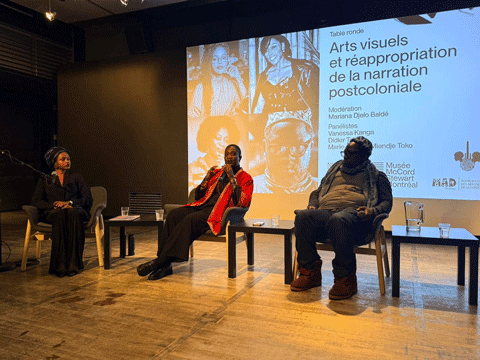
In May 2024, Vanessa Kanga was appointed head of the Culture and Library Division of the Côte-des-Neiges–Notre-Dame-de-Grâce borough. This appointment marked an important milestone: entering the heart of the institutional machine.
The transition from cultural entrepreneurship to public administration required a change in approach. It was no longer just a matter of proposing projects, but of managing budgets, prioritizing initiatives, and ensuring that actions complied with specific regulatory frameworks.She then develops strategic patience. Understanding administrative processes. Identifying room for maneuver. Embracing change over the long term. Her role becomes that of a conscious bridge: translating the needs of artists and communities to the institution, and reminding the institution that it must evolve to remain relevant to the clientele it serves.
Being a Black woman, a migrant, and an entrepreneur in Quebec's cultural scene inevitably influences her career path. She felt, especially in the beginning, the weight of having to prove her legitimacy.
“I wondered if my vision was perceived as too ambitious, too different, too political.”Winner of the 2024 ARISTA Award in the Young Entrepreneur of Quebec: Arts and Culture category and winner of Black History Month in 2025, Vanessa welcomes these distinctions with clarity.
For her, Black History Month should not be a mere moment of occasional recognition. It is an opportunity to celebrate past and present contributions, but also to highlight the persistent imbalances in access to resources, platforms, and decision-making positions.
She hopes that this period will serve as a catalyst for ongoing conversations, where contemporary innovation is discussed as much as historical memory.
To a young woman of African descent who doubts her place, she would say that this place does not depend on external validation. That it already exists, even if structures are slow to recognize it. And that sometimes transforming the space is more powerful than seeking to conform to it.
When asked what matters most—institutions, communities, or individuals—her answer is clear: individuals.
Because individuals who gain confidence and recognition can influence those around them. A structured community can then influence institutions. For her, change is systemic, but it always begins with human trajectories.
If she had to name one urgent transformation in Montreal's cultural scene, it would be the shift from discourse to structural action. Fewer symbolic gestures. More internal reforms capable of bringing about lasting change in power dynamics.
And if the young Vanessa could see the woman she has become today, she might be surprised to find that her voice carries weight. That she has helped to reshape certain spaces. And that she no longer needs to apologize for being ambitious.
Our
major
partners
